
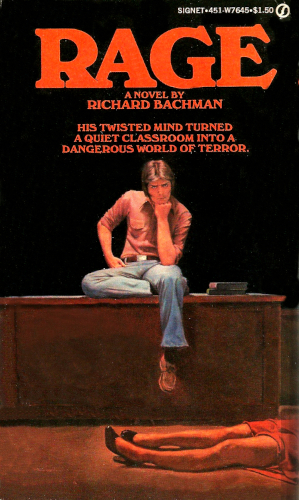
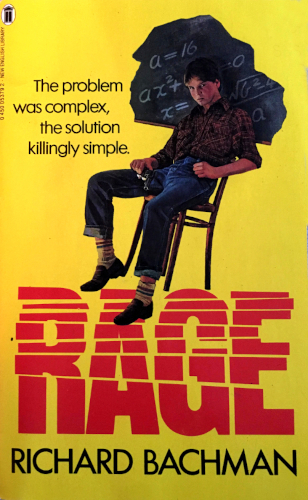
** spoiler alert ** *Spoilers for Rage, Catcher in the Rye, and Joker*
I saw someone describe this book as “the Breakfast Club with a gun.” That’s a pretty good description, but I’d almost say this feels like a sequel to or an alternate version Catcher in the Rye — like if instead of Holden Caulfield being suspended and walking home, he grabbed a gun and held his classmates hostage.
In fact, that’s what I’d describe this as: Breakfast Club meets Catcher in the Rye. There’s a lot of weird sexual things playing out with one sequence in particular that Charlie describes that has strong echoes of when Caulfield pays a prostitute just to talk.
I can’t say it’s bad? King is always an engaging writer, and his characterization is top notch, but it’s also not particularly good. The book is told from Charlie’s point of view, and he’s as unreliable a narrator as Caulfield. A lot has been made about the book being about a school shooting, and I can see why King let it fall out of print. This book feels like it’d be to school shooters how Joker feels like it is for incels. That same nihilistic, misanthropic pulse beats under this book.
Joker ends with Arthur being foisted on top of a police car and almost worshipped as a prophet bringing the truth of society’s corruption to the masses, and Charlie is treated similarly by his classmates. There’s a bizarre adoration they all express for him, even going so far as to state that they’re not being held hostage at all, and in fact respect what he’s done. And the way they barely react to the two teachers that Charlie kills after the initial shock wears off gives the whole book a very eerie, topsy turvey feeling. Ultimately, like Arthur in Joker, Charlie seems to be swallowed up by his own delusions of grandiosity and martyrdom, but also like Joker, it doesn’t feel like anything of note is said, nor is any meaningful point made.
There are some interesting themes played with: the way adults have an almost overweighted influence on the lives of children, and especially teens that are starting to develop into their own people; the way folks from broken or dysfunctional homes are shunned not just by their peers, but by the teachers who tend to use school as a way to reinforce the status quo; the way people who seem to have it all can be broken and petty and vindictive if their prestigious place is threatened. All of these themes, however, are explored better in Carrie. It’s worth noting both Rage and The Long Walk were written *before* he wrote Carrie, but published after.
Ultimately an interesting read, but more as a novelty due to its rarity from being out of print. It definitely doesn’t feel like a lost hidden treasure to me, just a story about an angry white boy using violence to get attention, which is and always has been an all too common occurrence.

