

Wendy: “I hate them.”
Chapter 16
Jack: “Wasps?”
Wendy: “Anything that stings.”
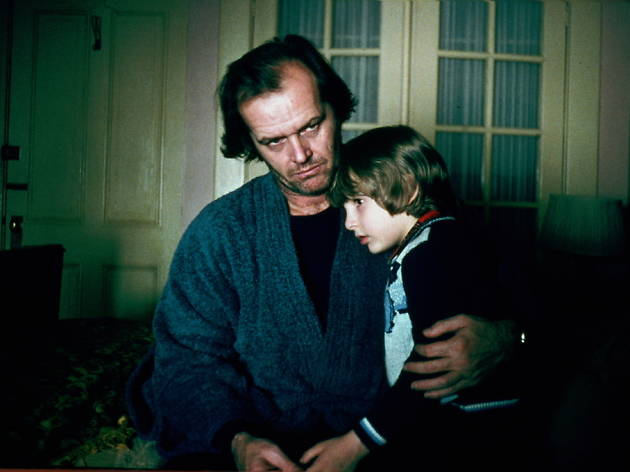
The Shining is possibly King’s most famous work, and that could ironically be credited to Stanley Kubrick’s movie adaptation, an adaptation that King has gone on the record repeatedly as saying he greatly disliked. It’s tough, and I would argue nearly impossible, to discuss the book without addressing the movie at least a little since it’s such a foundational movie — the carpet pattern in the hallways alone is enough to be identified on sight, after all. But first, I want to talk about the text.
There’s a LOT of stuff in here about Jack and his struggles with alcohol. It implies that he does have a temper issue that the alcohol exacerbates, but he does acknowledge that his drinking is a problem. He admits that he’s an alcoholic, although he does not go to AA or anything. He tries to quit on his own; or rather, he tries to moderate his drinking on his own.
Book Jack is a much different character from Kubrick Jack. Book Jack is a broken man who’s made a lot of mistakes and is doing what he can to try to right them. He’s hit rock bottom (or thinks he has), and after losing his job, possibly or possibly not killing a child, and beating up a student, the only job he seems able to land is caretaker of a luxury hotel. Book Jack certainly has a lot of the pride and disdain for disrespect that Movie Jack does — the Ullman interview at the start is very similar, although Movie Jack already appears half-crazed. There’s a simmering rage under his mannerisms that isn’t as apparent in the book. But it’s clear that Book Jack is presented in a much more sympathetic manner. While Movie Jack’s eventual murderous, psychotic break feels like an inevitability, Book Jack’s feels like the tragic fall of a man who was flawed by trying to be better.
Jack’s draw from the hotel is how they treat him as beloved, respected, indulged. The drink is how they help loosen his inhibitions, but it’s really the praise that’s the truest poison. In spite of the fact that it’s clear that the hotel actually wants Danny because of his ability to Shine, Jack refuses to believe this and insists that they really want him, not Danny.
As Jack worked on his writing and approached tenure in his teaching job, he relished the respect and adulation he received from the position. It wasn’t that he was praised a lot, but he felt better about himself. When he becomes caretaker of the Overlook, it isn’t just the only job he can get, it’s also the last chance he has to prove to himself that he’s not a fuck up. Ullman doesn’t want to hire him, and it’s only because of Jack’s rich friend Al recommends him that he even gets an interview. Ullman openly tells him he wouldn’t hire him if it weren’t for Al.
While Jack appreciates these favors, he also resents them because he feels beholden to Al, and everyone else that helps him, which is why he becomes so interested in writing a juicy tell-all book about the Overlook’s history. It would have the one-two punch of knocking Ullman and Al down a peg while positioning himself as Influential and Important. Whenever Jack’s temper flares, it’s after he’s experienced something that’s made him fear someone either undermining his authority or tampering with his legacy or his plans to regain legitimacy.
It’s worth noting that while he recognizes he has a problem and struggles to white-knuckle his way to sobriety (or at least moderation), he doesn’t go to AA. Since a solid chunk of AA involves surrendering yourself to a higher power, it makes sense that Jack couldn’t bear to humble himself by participating in such a program. He craves feeling superior and successful too much to allow himself to believe there may be things out of his control, and anything that is out of his control ultimately gets blamed as forces conspiring against him — bad luck, punishment from God, his friends or family not respecting him or actually hating him. He walks a weird duality of blaming and hating himself for his failures, while ultimately not believing they’re his fault but rather the fault of one malevolent force or another.
Book Jack’s dad was an abusive alcoholic as well, and there are a few moments in the book when Jack remembers his dad beating his mom so badly with his cane that she has to go to the hospital. Fitting then that in Danny’s visions, and when the hotel influences Jack, it’s his father’s words that come from Jack’s mouth: take your medicine, young pup, young whelp. Also fitting that to Jack’s father, and eventually to Jack himself (at least while under the hotel’s sway), “medicine” and physical punishment are the same thing — a healing beating that should rid the beaten of any weaknesses or failings like whacking the dust out of a dirty rug.
There’s a sharp thematic core about the tortured restraint of traditional masculinity. Expressing emotions other than rage and happiness are weakness. Asking for or receiving help, or failing in any way to handle things on your own, those are signs of weakness as well. Every act of charity or compassion given to Jack is an indignity and an insult, and any acts of charity or compassion that he would provide would deep down be a sign to himself that he is superior and has made the correct decisions.
To demonstrate this, we can examine Stuart Ullman and the caretaker who trains Jack on how to take care of the boiler. Stuart Ullman is described as queer — both as an insult, but also in his mannerisms, which are described as officious, stuff, prissy, even. Meanwhile, the caretaker, who’s presented as a very quintessentially masculine salt of the earth type, is a huge homophobe that uses the f-bomb in a hugely derogatory way. And there are a few points where Jack worries that Danny, with his quiet, sensitive demeanor, could be gay. This fear isn’t out of a concern for the hardship that Danny might face as a gay person, but rather a failing on Jack’s part to properly raise him as a man. When Danny is stung by a wasp, Jack makes crying over the injury seem like something childish and weak — big boys don’t cry, after all.
Jack is a fascinating character — he’s very openly flawed as a protagonist, and while his portrayal in the book is much more sympathetic than in the movie, it does raise the question: Is Jack actually sympathetic? Do his intentions matter? Ultimately Jack sacrifices his life to stop the ghosts of the hotel and to help Wendy, Danny, and Dick escape with their lives, rejecting the manipulative, false love and respect the hotel tries to tantalize him with. That’s a drastic difference from the movie, in which Dick is killed as soon as he shows up to help Danny, and Jack freezes to death after getting lost chasing Wendy and Danny into the hedge maze with an axe.
Whether that final act of self-sacrifice, an acknowledgement of his flaws and an attempt to redeem himself if only with his death, is enough to earn him sympathy and forgiveness is up to the reader, but given that this book was very heavily influenced by King’s own intense struggles with alcohol and substance abuse at the time, it’s inarguable that Book Jack is a more dynamic and nuanced character than Movie Jack. I wonder if that’s part of why King disliked the movie adaptation so much? It took his own personal struggles and turned them into a flat, cartoonish monster from the first frame.
 Whirling Nerdish