
 |
| This is a photo I took of our very own Confederate statue in the middle of downtown Bentonville. A petition is currently being circulated by a local activist group to have this removed–which I have signed, obviously. Arguments for this statue’s continued existence are because this guy was an Arkansas governor. If you zoom in on the picture, though, you’ll notice that it doesn’t say “to the Arkansas Governors.” It says “to the Southern Soldiers.” |
Why Secede?
“In all such territory the institution of negro slavery, as it now exists in the Confederate States, shall be recognized and protected by Congress and by the Territorial government; and the inhabitants of the several Confederate States and Territories shall have the right to take to such Territory any slaves lawfully held by them in any of the States or Territories of the Confederate States.”
[…]
“1. The importation of negroes of the African race from any foreign country other than the slaveholding States or Territories of the United States of America, is hereby forbidden; and Congress is required to pass such laws as shall effectually prevent the same.”
[…]
“4. No bill of attainder, ex post facto law, or law denying or impairing the right of property in negro slaves shall be passed.”
Was Slavery On Its Last Legs?
“Slavery was hardly on its last legs in 1860. That year, the South produced almost 75 percent of all U.S. exports. Slaves were worth more than all the manufacturing companies and railroads in the nation. No elite class in history has ever given up such an immense interest voluntarily. Moreover, Confederates eyed territorial expansion into Mexico and Cuba. Short of war, who would have stopped them — or forced them to abandon slavery?”
Memories and Stories Cast in Stone
 |
| “King Wenceslas” – Photo Some rights reserved by Nan Palmero of Flickr |
That’s not to say that statues and monuments have to be uplifting. Plenty of statues and monuments depict dark, terrible, or scary things. For example, below is an art piece from Switzerland called “The Child Eater Fountain.” This is a surprisingly not an uncommon depiction in art, although specifically what this statue is depicting is a bit of a historical mystery. Some theorize it’s a depiction of Kronos eating his children, which is what I thought of when I first saw it. Others theorize it’s just a depiction of a local ogre-like fairy tale to keep kids in line. Another theory is that it’s an anti-semitic sculpture because, sadly, people have been terrible forever.
 |
| By Andrew Bossi; sculpture by Hans Gieng (de) (Own work) [CC BY-SA 2.5 (http://creativecommons.org/licenses/by-sa/2.5)%5D, via Wikimedia Commons |
However, these statues of Confederates soldiers aren’t depictions of cartoonish, terrifying, child-eating monsters. The Confederate monuments and statues have a very particular look about them. Namely, they try to mimic the statues and monuments of Abraham Lincoln, Thomas Jefferson, George Washington, and other important historical figures in our country–which themselves are intentionally mimicking the style of ancient Greek and Rome.
A Picture is Worth a Thousand Words, How Many is a Statue?
 |
| Some rights reserved by Marc Flores on Flickr |
Depicting a figure on horseback also makes for a dynamic, interesting statue.
Horses are often considered noble creatures.
And, of course, it makes the person on horseback look taller because they are literally above everyone else.
 |
| Left: Some rights reserved by Marc Flores on Flickr | Right: Some rights reserved by rjones0856 on Flickr |
How is the statue of Stonewall Jackson on the right depicted any differently than George Washington on the left? If I’m to believe that the Confederate statues are a warning, how is the Jackson statue a warning? In what does it indicate a warning, or any negativity? Both men are sitting atop horses, are placed on pedestals, are sitting up straight, their heads held high, their eyes gazing forward as they survey the horizon.
 |
| Left: Some rights reserved by Jim of Flickr | Right: Some rights reserved by Eli Christman of Flickr |
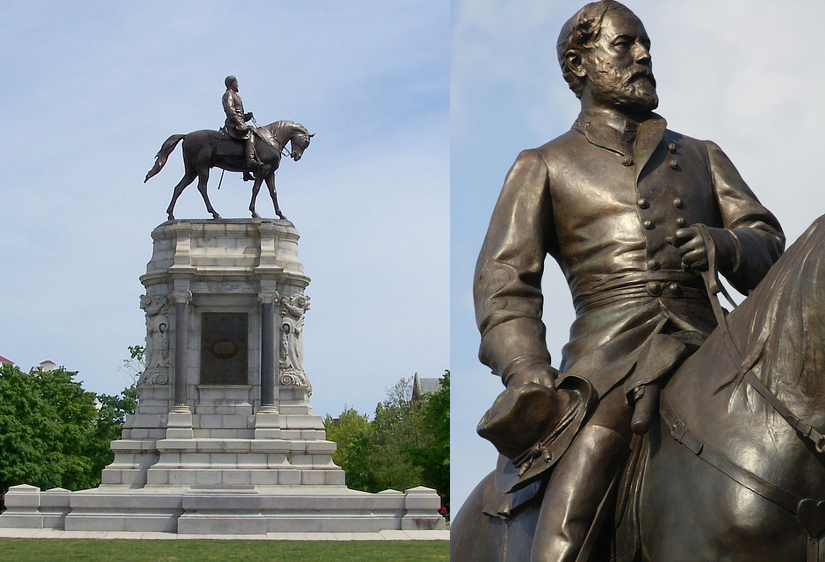
Look at these pictures of Robert E. Lee, Commanding General of the Confederate Army. These are different photos of the same statue from different angles. Again, just like in the previous pictures of Washington and Jackson, what is the indication that this is meant to be a warning of some grave past mistake? Lee is portrayed as classically empowered: astride a horse, straight back, head held high. Even his face is carved in a gentle, sensitive manner. He doesn’t look evil. He looks thoughtful and kind.
Let’s talk about something else: all three of these statues–in fact, many of the Confederate statues –are all literally placed on pedestals. This is a very, very common way to display statues since they are meant to be memorials, after all. It’s where the phrase “to put up on a pedestal” comes from in the first place.
But what does that phrase mean, again? According to Dictionary.com, it means “to glorify or idealize.”
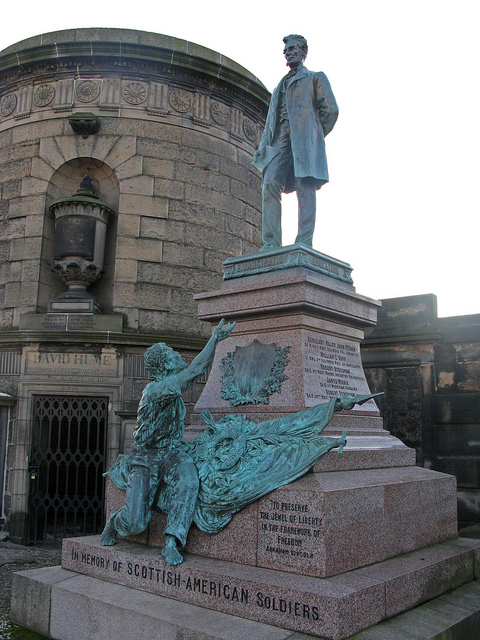
The only types of figures we generally put on pedestals are figures we want to elevate to higher status–both literally and figuratively. For example, look at this statue of Abraham Lincoln from Scotland that commemorates the Scottish soldiers that fought alongside the Union in the Civil War.
 |
| Some rights reserved by Ronnie Macdonald of Flickr |
Abraham Lincoln stands nobly at the top of the monument–again, back straight, head high, eyes gazing into the distance. Meanwhile at the BOTTOM OF THE PEDESTAL, a recently freed slave is gazing up at Lincoln in what is supposed to be deference and praise, but honestly looks like suffering and subjugation to me. Either way, it’s very clear from the placing of the two figures who has the power and who does not. The placement of those figures is basically symbolism 101.
Compare that Lincoln memorial to this memorial depicting slavery in Zanzibar, Tanzania, Africa.
 |
| By David Berkowitz [CC BY 2.0 (http://creativecommons.org/licenses/by/2.0)%5D, via Wikimedia Commons |
Here the slaves are all chained together. They’re prisoners both of their chains, and their lack of limbs which could be interpreted as a lack of personhood.
Rather than being placed on a pedestal, these figures have actually been dug into the ground. They have a sort of anti-pedestal going on, reflecting, among other things, their severe lack of power as well as the cellars that they were kept in.
The “Lost Cause” of the Confederacy
All of these myths that continue to be perpetuated about the Civil War–that the North forced the South into conflict, that the South just wanted states’ rights, that the war was really about taxes and tariffs, that Robert E. Lee was actually a kind man and not a racist at all, that slaves were actually happy, that a lot of Southern folks fought to defend their land against the cruel war-time tactics of the North–ALL of this stems from a misinformation campaign that began not long after the war ended by the South. The myth of the Lost Cause was an attempt to recast the Confederacy as this scrappy underdog standing against the crushing, unstoppable juggernaut that was the United States Army.
In truth, most of these monuments in the US started going up around the 1900s–just long enough after the war for a lot of people that fought in the war to start dying off and for everyone else to look back on the war with somewhat of a degree of separation. The pain wasn’t immediate anymore, the conflict starting to haze with time.
Statues began being erected again in the 1950s and 1960s in reaction to the Civil Rights Movement as an attempt to intimidate the black population into silence rather than speaking out. It’s why the arguments around Confederate statues and flags have begun resurging in response to Black Lives Matter and our current political environment, which so conducive to white supremacists.
Perhaps you think that I’m reading too much into these statues, that these statues of Confederate generals in and of themselves are harmless and I’m being too artsy fartsy reading symbolism into someone standing on a pedestal or sitting on a horse. Maybe you maintain that we can just add a plaque that says “actually the South was racist” and completely change the way the statues are perceived.
What about the statues that depict the Confederates as literally blessed by angels and gods?
 |
| Some rights reserved by Spencer Means from Flickr |
The above statue is titled “To the Confederate Defenders of Charleston: Fort Sumter, 1861-1865.” The statue is described as a Confederate soldier and his wife, but the Confederate has been depicted as a Greek warrior similar to Achilles or Hercules. Meanwhile, his wife is depicted in the style of a Greek goddess, similar to Athena. She’s bestowing a blessing on him as he heads into battle to “defend” Fort Sumter from the Union.
So, now the Confederates are literally being placed on the level of Greek heroes and their cause was blessed by the gods.
 |
| Some rights reserved by Ron Cogswell from Flickr |
Above we have a statue that depicts a fallen Confederate soldier from Louisiana. He has been wrapped in the Confederate flag, and a literal angel–“the Spirit of the Confederacy”–flies above the fallen soldier, sounding its horn to honor his sacrifice.
Like…I mean…c’mon, y’all.
But What About Our History???
So we have soldiers that fought AGAINST the United States and FOR slavery being depicted as Greek heroes and blessed by divine beings, meanwhile, slave rebellions in the US are memorialized like this:
 |
| Photos by Mike Stroud, November 15, 2008 from the Historical Marker Database |
This is a single sign in an empty field that commemorates an attempted uprising by our enslaved people. Why are we not valorizing these fallen heroes and other important black heroes? Why are town squares not built around Martin Luther King, Jr, or Malcolm X, or Harriet Tubman? Why instead are they built around literal traitors to the United States.
Hey, maybe build a monuments to people like Erastus Hussey, who was an abolitionist, one of the founders of the Republican Party (before the parties’ beliefs flip-flopped), and someone that helped slaves escape through the Underground Railroad.
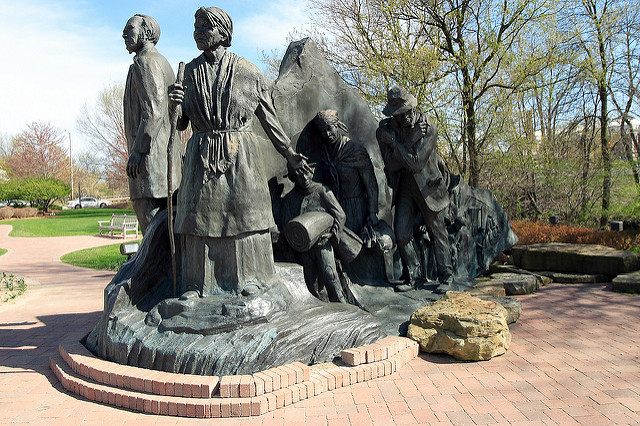
Look at how awesome this statue below is! Erastus and Harriet Tubman are sneaking people into his store to keep them safe. THOSE are heroes. THOSE are people this country should be proud of. THOSE are people worth having town squares built around.
And for the record, the figures below are valorized using the the same rules as the Confederates statues I showed above. Harriet Tubman and Erastus Hussey are both standing tall, heads high, staring into the distance, shielding the slaves huddled in the back while they scramble to safety. But notice that this statue isn’t placed on a pedestal like the ones above. Interesting…isn’t it?
 |
| Some rights reserved by Battle Creek CVB from Flickr |
In summation, slavery is America’s original sin. It is the cancer that we never fully dealt with. From almost the moment that the Civil War ended, white supremacists have been spreading misinformation to muddy the facts about the war and to misrepresent why we fought. Erecting monuments to the Confederacy honors people that were traitors to the US, who defected for a racist, brutal, horrifying system.
Attempting to argue that statues of the Confederacy are a warning is disingenuous, at best, as everything about the design of these statues valorizes them and promotes the depicted individuals into near godhood. A simple plaque stating “actually, they were bad” would not be enough as the entire design would contradict th plaque. It would be the weakest Band-Aid to stick on the problem without actually dealing with the issue…which is the problem the US has had all along: not actually dealing with the problem of racism and slavery in a meaningful way.
 Whirling Nerdish


[…] Let’s Talk About Confederate Statues […]