
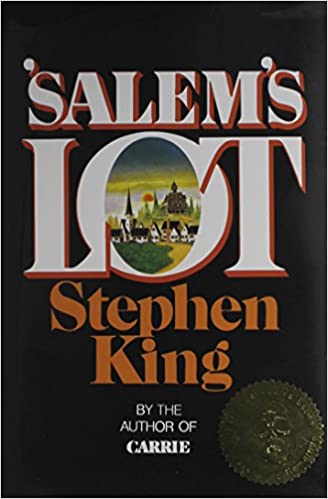

*Spoilers below for ‘Salem’s Lot (obviously) and The Dark Tower,
Two older gentlemen move to a small town in Maine to start an antique business. Valuing their privacy and comfort, they purchase a large, abandoned house on the edge of town and begin going about the business of setting up their shop. However, many of the locals treat their arrival with gossipy suspicion. They’re not from around here, which makes their presence novel at best and suspect at worst. Their store is a bit out of place in rural Maine, selling high-end antiques to farmers and factory workers, but it generates some buzz and the man that runs the store is charming. Of course, there’s the other things. The meticulously stylish and clean way that Straker dresses. His prim mannerisms. The fact that neither Straker nor his “business partner” Barlow have wives. The fact that they live together in that big house at the edge of town…
Vampires have been heavily queer coded almost since their introduction into pop culture. Bram Stoker, the writer of Dracula and great-granddaddy to the vampire genre, was very likely a closeted gay man himself, and began working on Dracula around the same time that his very close friend Oscar Wilde was sent to prison for being gay. Richard Primuth for the Gay and Lesbian Review said that the homoeroticism in Dracula was actually a closeted Stoker working through his own anxieties in a time that was extremely unfriendly to queer folks. In fact, Bram Stoker had a large fascination and respect (a love) for Walt Whitman, who himself was believed to be gay. The love letter that Stoker wrote to Whitman is very sweet and shy, equal parts fangasm and romantic crush. So it should come as no surprise that ‘Salem’s Lot has heavy themes of masculinity and homosexuality.
When Ben Mears first arrives in the Lot, he’s immediately greeted with suspicion by the locals in much the same way that Straker and Barlow are. They arrive in town around the same time, all three are unmarried, and all three have jobs that aren’t traditionally masculine — fashion and interior decoration have been associated with queerness for a long time, and while not all writers are gay, writing is vulnerable, sensitive work and requires a level of emotional awareness that men are not traditionally afforded. Though superficial, there’s enough similarities that even the sheriff at first wonders if the three of them might be queer, and suspects Ben of working with Straker and Barlow to kidnap the local children. That is the first of many references to homosexuality, direct and subtle, whether intentional or not.
One of the ugliest and most deeply bigoted stereotypes of gay men is that being gay doesn’t just involve attraction to men, but to children. Gay men have been portrayed as predators of children and pedophiles for a long time, and while I don’t think King intended to call that stereotype up, since the first disappearances in the Lot are children, and since the disappearances started around the time that the three suspected queers moved into the area, it’s an unfortunate but unavoidable association. While we never learn for sure what sexualities Straker and Barlow have, we only have their set dressing and queer coding to go by, and they are indeed responsible for everyone that goes missing, starting with the children. Like I said, I don’t believe that King intended that, but it’s there.
So while vampires may call up images of the monstrous homosexual preying on the weak and innocent, I don’t want to give the impression that ‘Salem’s Lot is just a tome of queer-bashing and vitriol. Traditional masculinity is, in fact, portrayed much worse throughout the novel. Susan’s ex-boyfriend Floyd Tibbets shows up at one point and beats the shit out of Ben, sending him to the hospital — although it may be because of Barlow’s influence, the jealousy and hatred of Ben was already there. Then there’s Reggie Sawyer and Roy McDougall, both of whom are horrifying, abusive monsters to their wives. Reggie catches his wife having an affair with Corey Bryant and proceeds to hold him at gunpoint, making him even put the gun barrel in his mouth before doing much worse to his wife in retaliation. And Roy McDougall is an abusive douchebag who seems to hate his wife because she had the audacity to get pregnant.
Even the good men that are more traditionally masculine show cracks in their facade that spawn from their inability to express or acknowledge their emotions. A lot of these men end up treating any sadness or discontent with alcohol, like Weasel Craig and Father Callahan. Weasel ends up ruining his relationship with Eva Miller, and Father Callahan has a crisis of faith that ultimately results in him being abandoned by God and cursed by Barlow after their brief encounter. Even Sheriff Parkins Gillespie shows the strain that emotional detachment causes. Parkins, like Callahan, flees the Lot in shame when he finally acknowledges his own fears of what’s brewing in the Lot. Instead of joining forces with Ben and his crew, he flees and leaves residents of the Lot to their own fates.
To me, Ben’s and Susan’s relationship feels forced and awkward. I don’t think this is intentional on King’s part either — his ability to portray romance has been a bit hit and miss in my experience — but nonetheless Ben’s relationship with Susan feels a lot like Henry’s relationship with Elizabeth in Frankenstein — awkward, passionless, forced to the point of feeling performative. The romance scenes read like they’re supposed to be sweet and passionate, but for me at least, they just feel goofy and corny. It’s worth mentioning that Susan and Ben’s courtship may read as hokey in part because of Susan’s love of romance novels. She pictures Ben as a romantic hero who’s sprung from the page to whisk her away from her small town life.
For my money, Ben Mears feels like a closeted bisexual. He’s not strictly gay because he had a wife who passed away in an unfortunate accident prior to the opening of the novel, and yet the choice to give Ben a heterosexual relationship with Susan almost feels like a desperate attempt to “no homo” the protagonist. In a way, signaling that he isn’t queer sort of exonerates him from much suspicion in the town. He certainly still has softer, less traditionally masculine tendencies, but Ben’s alleged heterosexuality at least partially sets him apart from Straker and Barlow, who are much more traditionally queer with their interests in fashion, décor, and manners.
There are other instances of explicit and implicit queerness. In one chapter as the vampires descend on the town, King hops from townsperson to townsperson, giving us one final snapshot of their lives before the evil wipes the town clean. One of those perspectives is George Middler, a very minor character who’s only really notable because the last we see of him, he’s wearing feminine clothes and looking at himself in a mirror. It’s implied that he’s homosexual, but his enjoyment of wearing feminine clothing makes him at least genderqueer. I can’t say George is really vilified, nor can I say it’s even implied as insidious. It definitely fits into the themes of “small towns have buried secrets” that King explores in a lot of his books, but I couldn’t discern much of a judgement for or against. It’s an odd detail to include, not because George’s behavior is odd, and more because it feels like such a throwaway detail unrelated to the rest of what is described.
Matt Burke, the local English teacher, also reads as closeted to me. I don’t think the book ever establishes Matt’s exact age, but he’s definitely older since he’s taught probably half the town. There’s a scene in which he sits down to talk with Mike Ryerson and after seeing how sickly Mike looks, Matt takes Mike to his own home to let him rest so he isn’t alone. Matt is very much a fatherly figure in the novel as well as playing the wise sage a la Van Helsing. But there’s something about the framing of the scene — the touching concern Matt expresses for Mike, Matt’s waitress being so aghast at seeing Matt drinking with Mike — that feels almost like a pickup scene. And vampirism’s use as an allegory for AIDS reinforces the queerness of the scene. Which brings me to Matt’s relationship with Ben.
Contrasted with the hokum of Ben and Susan’s relationship, Ben’s connection with Matt feels far more genuine to me. These men are both students of the written word — Matt a teacher and Ben a writer — and both are single. They develop a fast friendship when they meet and bond over the spooky local legends of the Marsden house, so much so that Ben is the first person Matt calls when he fears vampires have killed Mike Ryerson. This relationship, although it could be seen as paternal or even mentorial, feels similar to Henry’s relationships first with Dr. Waldman in Frankenstein (1931) and then with Dr. Pretorius in Bride of Frankenstein (1935). There’s a long history of gay relationships with significant age gaps — Milk, Gods and Monsters, Call Me By Your Name, and the recent Shudder original Spiral are just a few examples. In fact, Ben even brings up that if they try to take their story about vampires and Mike Ryerson to anyone else, they’ll suspect the two of them of being gay lovers.
Of course, there are tons of other themes in the novel to explore. Vampires can represent the past coming back to punish people for forgetting and failing to honor the old ways and traditions. They can also represent the fear of youth and the changing of the times. They can represent Christianity and the wrath of God punishing those who fail to walk in his light. And, of course, they can also represent addiction, which is relevant to a huge chunk of King’s works as he struggled with his own addictions. But maybe it’s because I myself have come out since the last time I read this book, but I couldn’t escape the queerness of the vampires this time around.
___________________________________
Some unrelated notes:
I appreciate in King’s introduction to the later printings how he lays out his thought process for how he decided to handle the vampires of his novel. It’s a smart angle to take — cross the class and sophistication of the old school vampires like Dracula with the feral, blood-splattered animalistic feeding of the vampires from EC Comics. There’s something about the image of a stuffy, emotionally repressed man suddenly turning into a wild-eyed maniac, the shattering of the thin veneer of calm to reveal the monster underneath, that has appealed to folks for generations — The Strange Case of Dr. Jekyll and Mr. Hyde for example. And it’s an image we’ll see again in The Shining.
There are some fun connections to King’s other works here, too. Father Callahan becomes an important character in the latter 3 Dark Tower books. When Mark is visited by vampire Danny Glick, he fends off his glamour by saying, “He thrusts his fists against the post and still insists he sees the ghost.” This, of course, is a phrase that Bill Denbrough uses to combat his stutter in It.
And although this is a throwaway line, the description of Susan’s mom when she’s sent by Barlow to kill Matt Burke in the hospital still caught my attention: “Ann Norton drew the .38 from the pocket of her wrapper like some creaky gunslinger from beyond time.” While ‘Salem’s Lot predates the publishing of The Gunslinger, I believe at this point King had already written several serialized short stories about Roland for Fantasy and Science Fiction Magazine, so I don’t think the reference is coincidental.
___________________________________
Some more reading about vampires and queerness:
 Whirling Nerdish