
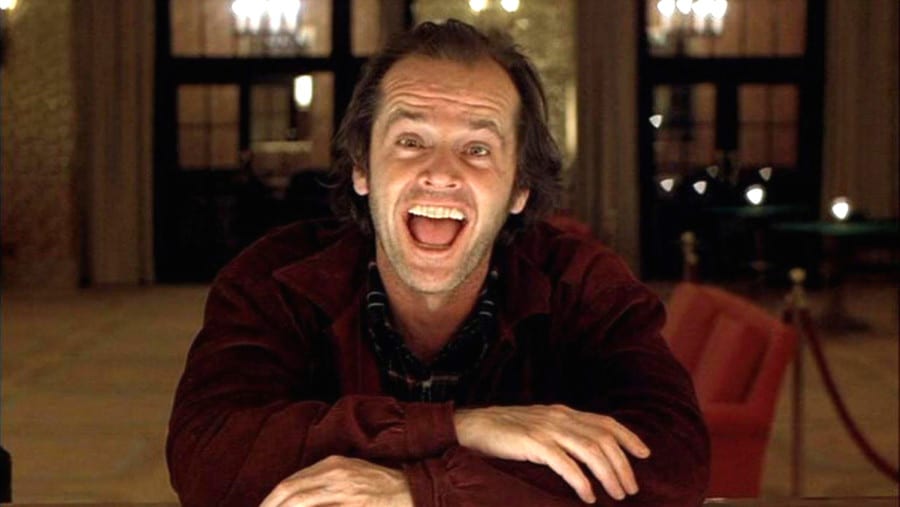
Nicholson’s Jack may have been pretty sinister from frame 1, but Danny’s creepy Tony voice, Shelley Duvall’s heartbreaking turn as Wendy, and the several surreal and terrifying haunts — the twins, Grady, the elevator of blood — makes this still an astounding movie.
Everyone knows that it’s not an accurate adaption of King’s novel, but it’s also not trying to be, which is why its title is STANLEY KUBRICK’S THE SHINING. King may not like it, but his assessment was accurate: the book has a lot of heart and warmth, while Kubrick’s movie is distant, cold, and a bit nihilistic — which isn’t a criticism to me, but a different way of viewing the source.
Jack in the book, as in the movie, hurt Danny when he was drunk. While the book makes the argument that Jack is ultimately a good man plagued by demons he can barely control, this movie posits that, no, actually maybe he was a monster with barely covered rage simmering under the surface.
It’s also a meditation on masculinity and how men, intentional or not, expect to be accommodated and tip toed around, their own pain and inconvenience being more important than anything women may be dealing with.
I think men watch Jack and see a man driven to madness by isolation and supernatural elements.
I think women watch Jack and see the violent potential in every man they know.
So no, not an adaption of the books, but much the way Mary Harron’s AMERICAN PSYCHO re-examines the book, not so much adapting it as responding to it, so too does Kubrick’s THE SHINING.
 Whirling Nerdish