

Are you on Twitter? If you are, you probably know it’s a swirling dumpster fire of awful. It is a place where all of the nightmares of our world can endlessly scroll before your eyes like a portal into the darkest circles of hell.
The normal news cycle would be exhausting enough, but it’s also overrun by white supremacists, Nazis, harassing bots, and worse, they’re all treated as rational and deserving of space to say whatever they want because of freeze peach.
Enter Mastodon, the latest attempt to de-throne Twitter (and the rest of the social media juggernauts). On its surface, Mastodon is a Twitter clone with a higher word count allowance–500 instead of 280. When you log in, it even looks exactly like Tweetdeck, but with different skins. Underneath the hood, though, there’s some really cool stuff both on a functionality level and a basic structure level that makes it at least a potential Twitter contender.
The Basics
The code that Mastodon is written in is open source, which means anyone can go out and make suggestions and start projects to make improvements to the platform. This is cool because it means, were you sufficiently talented and motivated enough, you could write up and introduce improvements to the platform. It’s community based rather than answering to the board of directors at Twitter.
Functionality
Setup to Mastodon can be a tad complicated, and I want to talk more in depth of how it works and the pluses and minuses, but let’s save that for later. Let’s pretend you’ve already signed up and are ready to start using it.
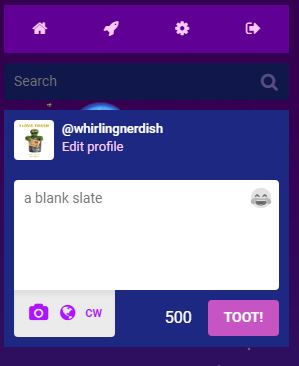
- Like I said, it’s a Twitter clone in a lot of ways. It’s laid out like Tweetdeck, and functions almost the same.
- The tweets are called toots. TOOTS!
- Because of elephants. Get it?
- You can:
- Toot something
- A normal post
- Boost something
- Similar to a retweet or reblog
- Favorite something
- Similar to most social media platforms
- Toot something
- You can add media to your posts — image, videos, etc. — and the platform will generally format them so that they look nice and fit the layout.
- The pictures aren’t quite as sleek and functional as on Twitter–you can’t just swipe from picture to picture–but it’s not clunky either.
- The little globe symbol at the bottom of the message area is your privacy settings. You can set toots to go out:
- Publicly (everyone can see it, including outside your followers)
- Followers only (so that it’s only visible to your followers
- Unlisted (I’ll explain more in a sec)
- Direct
- This is how Mastodon direct messages–it looks just like a tweet in your feed, but it can ONLY be viewed by the person that you sent it to (and the admins that mess with the code, but that’s obvious).
Instances
The most complicated aspect of Mastodon is the concept of instances. This is because Mastodon isn’t a centralized thing, per se. With Twitter and Facebook, there is one centralized platform that has one board that oversees the enforcement of rules. Mastodon is a framework on which anyone can start their own mini-Twitter…or mini-Mastodon, if you will.
That already sounds weird, so let me back up a second.
If you’ve used Reddit, you know that there is Reddit, the overall application, and then there are subreddits–rooms that you can enter that have their own rules for what’s acceptable. You can interact with the people of r/fantasy (a fantasy devoted subreddit) for years and never have to speak to anyone outside of there.
Mastadon is very much like that. The difference is, with Reddit you still only have one account and one group of official people that oversees the Official Reddit Rule Enforcement. Each Mastodon instance–each “room”–requires a separate account, however.
The really cool thing about Mastodon is you don’t have to be part of an instance to follow someone from that instance. So, I joined tootplanet.space* because it was queer friendly, had very straightforward rules, and I loved the space theme. A lot of the SFF authors I follow on Twitter, however, joined wandering.shop, which is intended to function kind of like an online science fiction/fantasy convention where you can talk about SFF books and TV shows and interact with authors and fans. I can still follow those authors and interact with them while being a member of my instance.
Some people stressed about which instance to join, and one of the flaws of Mastodon is that there aren’t obvious ways to find what’s out there. A tool does exist, but if you don’t know about it, you might miss it. You can go to https://instances.social, which has a tool that will ask you questions and help you narrow things down to some possible options based on what languages you speak, how many users you want in your instance, and what specific moderation rules you’re either for or against.
But why instances? Why set it up that way?
Home, Local, and Federation
When you setup your account on your instance, your home timeline will probably have one or two accounts that you auto-followed–that’s usually an admin account of some kind, kinda like Tom from MySpace. Beyond that, your timeline will be empty.
There are, however, two other timelines that you can look at: Local, which is a stream of everyone in your instance, and federation, which is a combination of everyone that you follow and everyone that the people you are following follow. (That’s not 100% accurate, but it’s close enough for these purposes.)
This is how I saw it explained on Mastodon that helped clarify things a little:
- Home – this is my home, and it’s full of my friends whom I invited in.
- If you post a toot “followers only,” it will go to your followers’ feeds only.
- Local – this is my neighborhood where I chose to live.
- You won’t follow everyone you see here, and not everyone you follow appears here. This is your local community.
- When you post a toot “unlisted”, it will not post here.
- Federation – this is the city I’m staying in. It’s full of friends of friends.
- All of the people you follow will appear here, along with everyone that they follow
- Posting toots “unlisted” means it won’t show up here, either
Dipping into the latter two feeds will give you suggestions on who to follow beyond searching for someone.
And? So what?
Recently on Twitter, I saw a white supremacist call someone the n-word. When the person responded by calling the white supremacist a “fucking racist,” they were suspended for a week. The white supremacist wasn’t disciplined by Twitter.
Twitter is driven by ads and media buzz. They have shareholders and a bottom line. It’s a business, and it’s trying to sell you things and sell you to advertisers so they can sell you things. Because of that, it means that, in spite of any rules they may have in place, they’re not incentivized to kick off the Nazis unless they have to–in Germany, Nazism is illegal, so those accounts are blocked there. Just not here because of freeze peach.
Because Mastodon isn’t centralized, as long as you join an instance with good moderation rules and an active admin, you don’t have to deal with that nonsense. Abusers can be banned from the instance, but it’s better than that. Your admin can ban entire instances from interacting with your instance. writers.blah can decide that they don’t want to deal with nazis.shitheads and ban the entire instance. In fact, tootplanet.space* had a list of banned instances and why they were banned. It’s one of the reasons I decided to join them–they were very straightforward.
Each instance has its own set of rules, so some instances allow literally anything. Some are more restrictive. Some allow NSFW posts untagged. Some don’t. Some allow swearing. Some don’t. That’s the beautiful flexibility of instances. AND you can still follow folks from other instances with different rules, too. So you can follow that puppet porn account all you want, even if your instance doesn’t allow YOU to post puppet porn.
What’s the downside?
Because each instance is a separate account with a separate password and separate settings, if you were to decide that the instance you’re in doesn’t fit, you have to create a new account elsewhere. There’s some nice tools put in place to bring your mute, block, and following lists with you so you can keep what YOU see the same, but you can’t bring your followers with you.
Some people really want there to be a single account that you create, and then you can check into different rooms as you wish. There were legitimate concerns raised of people being able to impersonate other people in other instances, and since there’s no centralization, it’d be next to impossible to get rid of them all. There’s no central authority, so there’s no “verified” option like on Twitter. This is a legit concern.
Although Mastodon has been marketed as “Twitter without the Nazis” that’s not accurate. As I said, Nazis can join an instance or create their own. It’s up to the admins of whatever instance you join to block them and keep them out. It would be pretty easy for the Nazis to whip themselves into a frenzy, mob an instance, and bring it down from the inside, and everyone would have to just start new accounts elsewhere, which is a bummer.
There’s also the possibility that you could run afoul of the mod and get booted for whatever reason. As Chuck Wendig pointed out, mod drama back in the BBS days was real and it would be easy for a mod to take a sudden disliking to you, and you’d just lose that account.
There also needs to be better muting in place. You can mute and block users, but muting keywords is restricted to a by-column basis. Just because my instance is good about not posting spoilers for Thor Ragnarok doesn’t mean that everyone in the Federation timeline would be. Plus, if I absolutely never want to see the word rutabaga, I should be able to mute that universally. Unfortunately, that’s not the case for right now. You can, like I said, mute keywords by column, though, which is nice.
Another functionality that I miss is making lists. I have a list on my Tweetdeck of my friends so that, even if I don’t want to read through my whole feed, I can get an update on how they specifically are doing. That functionality isn’t present at this time.
These are real issues, and if the platform continues to grow, these are things that they would either need to come up with answers to or figure out work arounds for.
Final thoughts
I really dig it. Like, a whole lot.
I think community policing is a really great way to deal with most harassment issues, including being able to just completely ban an instance so you don’t have to deal with the shit gibbons at all.
I also like the additional functionality of the content warnings letting you hide potentially sensitive information and letting users choose for themselves whether they want to engage. Politics, whether you agree with someone or not, has made Twitter into a nightmare where joy goes to die most of the time. It may be the front line for the resistance, but it’s also front line of my sorrows.
And finally, Mastodon puts the social back in social media. There’s an interesting sense of pride and identity, especially in the smaller instances. You feel like more of a tight knit community, and you all agree on what you consider acceptable. You don’t have to follow everyone in your instance, but you’ll likely still interact with a lot of them, and you can always drop into the Federation stream to get a sense of what Mastodon as a whole is talking about–at least within your circles of interest. And that’s really cool.
I hope this sticks around. An awful lot of people moved over there, but I can see the instance confusion being a barrier to entry for a lot of folks, and the potential for impersonation in other instances is higher than I would like. For folks looking to use it as a marketing platform like Twitter, it doesn’t function as well as Twitter does for that. But for everything else, it’s so much more enjoyable.
Check it out. See what you like. Hit me up. Follow me. I’m @whirlingnerdish@tootplanet.space
*(2022 edit: tootplanet.space no longer exists and attempting to go there triggers a malware alert, so don’t go there.)

 Whirling Nerdish